The Problem of Success in the Bolshevik Revolution

The Problem of Success in Bolshevik Revolution

The Bolshevik Revolution of November 7, 1917, achieved astonishingly rapid success, but this victory created unforeseen challenges. Lenin and the Bolshevik Party, skilled in revolutionary tactics, suddenly faced the complex task of transforming a clandestine group into a functioning government. Lacking a clear program, the party relied on slogans, improvisation, and Lenin’s leadership to navigate … Read more

Lenin’s Vision of Proletarian Revolution and the Withering State

Revolution in Prospect

Lenin’s State and Revolution provides a blueprint for the proletarian revolution and the transition from capitalism to socialism. Analyzing Marx’s theory and revolutionary history, Lenin emphasized the necessity of class struggle, the dictatorship of the proletariat, and the eventual withering away of the state. While visionary, his expectations often diverged from practical outcomes, shaping the … Read more

Lenin’s Strategic Approach to the March Revolution in Russia

Approach to March Revolution

The March Revolution of 1917 marked a turning point in Russian history, with Lenin seizing the moment to merge the bourgeois and socialist revolutions. Observing from exile, Lenin adapted Marxist theory to the rapidly unfolding political realities, prioritising practical action over rigid ideology. His strategy redefined the role of democracy, majority rule, and the soviets … Read more

Lenin’s Analysis of Imperialist Capitalism and Its Global Impact

Imperialist Capitalism

Imperialist capitalism represents the highest stage of capitalist development, where monopoly and finance capitalism dominate, and nations compete globally for resources, markets, and labor. Lenin analyzed this phase in the context of World War I, highlighting the betrayal of socialist parties, the temporary pacification of the European proletariat, and the exploitation of underdeveloped countries. Understanding … Read more

Bourgeois and Proletarian Revolutions: Marxist Theory, Lenin, and Trotsky

The Bourgeois and the Proletarian Revolutions

The concept of bourgeois and proletarian revolutions lies at the core of Marxist political theory. Marx, Engels, Lenin, and Trotsky debated whether societies must pass through fixed historical stages—from feudalism to capitalism and finally socialism—or whether revolutionary transitions could merge. The Russian Revolution transformed this theoretical debate into a historical reality, reshaping Marxism and revolutionary … Read more

Lenin on Dialectical Materialism: Philosophy, Power, and Revolution

Lenin on Dialectical Materialism

Lenin’s interpretation of dialectical materialism reveals the fusion of philosophy and political strategy in Marxist thought. By transforming dialectics into a universal method for understanding history, science, and politics, Lenin reshaped Marxism into both an ideological weapon and a revolutionary guide. His approach illustrates how philosophical theory can become a tool of power, redefining truth, … Read more

Lenin’s Theory of the Party: Vanguard, Ideology, and Democratic Centralism

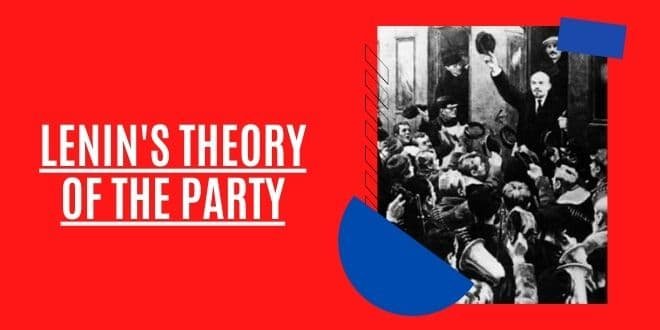
Lenin's Theory of The Party

Lenin’s theory of the party transformed Marxist political organization by introducing the concept of a disciplined vanguard elite guiding the working class toward revolutionary consciousness. Rejecting spontaneous proletarian activism as insufficient, Lenin argued that socialist ideology must be introduced from outside the working class by trained intellectuals. His model of centralized leadership, ideological unity, and … Read more

Russian Marxism: Origins, Strategy, and Lenin’s Revolutionary Model

Russian Marxism

Russian Marxism emerged as a distinctive adaptation of Marxist theory to Russia’s agrarian society and political conditions. Unlike Western Europe, Russia lacked a strong industrial proletariat, forcing Marxists to rethink revolutionary strategy, party organization, and the role of peasants. The debates between Bolsheviks and their rivals, combined with Lenin’s tactical leadership, shaped the ideological and … Read more

Leninism and Marxism: Evolution of Communist Political Philosophy

The Philosophy of Communism

Leninism represents a transformative evolution of Marxist theory, adapting classical Marxism to the realities of imperialism, revolution, and non-industrial societies. Developed primarily by Vladimir Lenin and later institutionalized as Marxism-Leninism, this ideology reshaped communist movements worldwide by combining rigid doctrinal orthodoxy with pragmatic revolutionary strategy. Understanding Leninism reveals how Marxist theory evolved into a powerful … Read more

Marxist Revolutionary Strategy: Socialism, Communism, and the Path to Revolution

The Strategy of the Social Revolution

Marxist revolutionary strategy shaped modern political movements by proposing two distinct paths to social transformation: gradual reform through democratic socialism and rapid revolution led by a proletarian vanguard. From Western European party socialism to Lenin’s revolutionary communism, Marx’s ideas influenced radically different political strategies that continue to define debates about revolution, democracy, and class struggle … Read more