
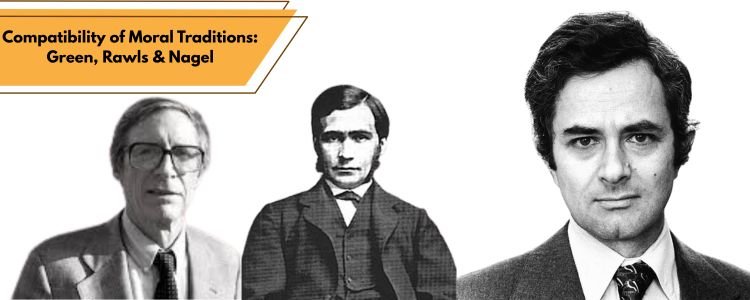
The central focus of the essay is the comparison and compatibility between the British Idealist moral philosophy of T. H. Green and the contemporary liberal theories of Rawls and Nagel, especially regarding value pluralism, moral conflict, and volitional vs. epistemological aspects
Bringing Two Different Traditions Together: Compatibility of Themes and Contexts
There is an overlap as well as a difference between the problems that Green and his contemporary counterparts face. Rawls and Nagel address the fact of pluralism: the fact that people who hold incompatible comprehensive doctrines of the good have to live together and share common institutions. The sue whether we can reconcile conflicting understandings of how to lead a good life.
Green discusses a problem similar in some ways: how can a philosopher help us deal with our moral ‘perplexities’? A good example is Antigone’s moral dilemma as to whether to obey the law of the state or the dictates of her religion? Again, as with Rawls and Nagel, we have conflicting moral theories of the good.
The difference is that for Green the subject of the moral conflict is a person, while for Rawls and Nagel it is a community. Green aims to give philosophical advice to a person who has to choose between two doctrines, while his contemporary counterparts take on themselves the task of reconciling the conflicting doctrines—that is, the groups of people who ‘profess’ these doctrines. They aim to give advice to governments on how to reach decisions, to legislators on how to make the law, to philosophers on how to adjudicate between conflicting claims to the truth.
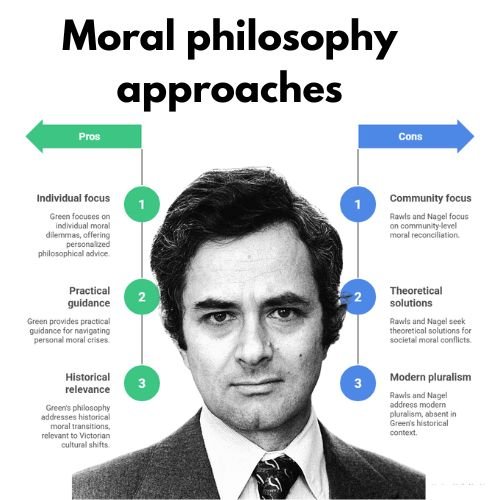
Their focus is not so much on how an individual can cope with the fact that his community is in conflict with another one, but on the theoretical possibility of finding the right solution. This will partly explain why Rawls and Nagel are less concerned with the volitional aspect of moral action. Traditionally, the moral will is associated with an individual, not with a group of people.
I will return to this issue in section VIII. At this stage, I would like to make two points. First, that although there are some differences in the themes they discuss, the overlap is sufficient for the purposes of a useful comparison.
The question How do we deal with conflicting ideas about what our duties are? is addressed by both parties to this comparison. Second, the different solutions which the two parties offer are partly explained by their different focus on the problem. My claim here is that Green’s approach to the issue is to be recommended. The fact that Green is concerned with the person who experiences moral difficulties, while Rawls and Nagel take a more external philosophical perspective of finding the right answer, puts Green in a better position to assess what is at stake during a moral crisis.
The difference of historical contexts also has to be addressed. An obvious objection to a comparison between end of twentieth-century and end of nineteenth-century thinkers on the issue of value pluralism is that the latter did not have to face the fact of pluralism. The phenomenon of close coexistence of communities from different cultural backgrounds was not familiar to Green. What Green had to deal with, however, was the moral crisis of a generation that needed to find secular justification for moral norms that had until now rested on religious narratives.
Melvin Richter argues that the reason for Green’s great influence in late nineteenth-century Oxford was precisely his ability to resolve the crisis of the religious consciousness. Richter claimed that the vitality of Green’s philosophy can be understood if we appreciate the fact that Green lived in times of cultural change.
So Green was addressing pluralism not in the sense of there being different communities, holding different moral values and having to live together, but in the sense of one community having to survive the move from one set of moral values to another. It can be argued that the task of the Victorian intellectual who had to reinvent his identity was harder than that of the late twentieth-century liberal who has to understand and accept ideological difference.
It is not easy to be impartial towards other people’s moral beliefs, but it is even harder to conceive how you can retain long-term impartiality towards your own moral commitments. In either case we can benefit from moral philosophers practical guidance. Both parties offer us such.
The Practical Value of the Distinction between Volitional and Epistemological Aspects of Moral Action
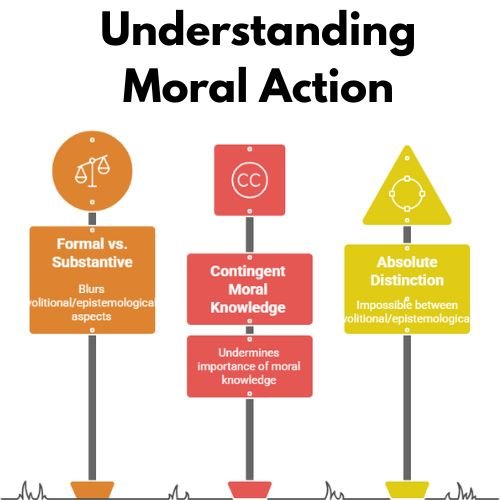
The distinction between the volitional and epistemological aspects of moral action is rather straightforward the first is to do with moral will, the second with moral knowledge. Here I want to explain why such a distinction is useful for the analysis of moral action. In order to do so, I will draw a comparison between this distinction and another, more familiar one that between the formal and the substantive definitions of moral action. The argument is that there is a link between the formal and the volitional aspects of moral behavior, on the one hand, and between the substantive and the epistemological aspects, on the other. My purpose is to demonstrate that the universal elements of moral action reside predominantly on its volitional side.
Green follows Kant in giving a formal account of moral action. While for Kant it is the will to conform to a universal law for its own sake or because it is conceived as a universal law, Green claims that people’s moral conduct consists in their imposition on themselves of rules requiring something to be done irrespectively of any inclination to do it. A formal definition describes the conditions, not the content of the moral action. Its formal nature allows it to be universal.
Because it applies to moral conduct in general, it is not associated with any specific object. What Kant’s and Green’s definitions imply is that the most general feature of moral action is the way in which a person is engaged in it. It is not so important what we do, but how we do it. Green argues that the moral good is to be found in the good will. The good will, according to Green, is one’s preparedness to pursue an object in a self-disinterested manner, The good will is about one’s desire to do a good thing and one’s preparedness to pay some personal cost for doing so. We are moral agents because we have an ability to pursue an ideal.
As will be pointed out in the next paragraph, the formal account of morality is not the only one: Green needs a second, substantive account. My argument is that the formal account of moral action defines one side of it—the volitional side.
The volitional element is about the actual engagement with moral action, It is about preparedness, commitment, and exercise of will. Rawls refers to the volitional aspect of morality when he speaks about strains of commitment: the costs that some will have to pay when they obey the principles of justice.
However, this is not central to his discussion. As opposed to being a key part of the discourse about what it means for a person to act justly, the strains of commitments are seen as something undesirable but of which we should be aware. To add extra emphasis on this point, would say that the volitional aspect of morality is not represented in Rawls’s vision of the formal structure of moral action.
In addition to his formal account, Green gives a substantive account of moral action. He comments that Kant’s purely formal account of morality is a shortcoming of his theory. Green points out that when we try to apply such a purely formal definition to practice, we can encounter two problems: either a dead conformity to the code of customary morality, anywhere and at any time established, without effort to reform or expand it, or else unlimited license in departing from it at the prompting of any impulse which the individual may be pleased to consider a higher law.
Green’s determination to give a specific description of the moral ideal is also partly a response to the utilitarian challenge. Utilitarian’s answer a question which a formal theory of Kantian type does not: towards what is the good will directed? While Green does not agree with the utilitarian’s that the answer to this question is ‘pleasure’, he none the less thinks that a moral philosopher should be able to give an answer.
For Green, the object of moral behavior is human perfection. And the only way to achieve human perfection is to create society where everybody has chances to develop their capacities. The ‘true good’, which is the same as the ‘moral good’, can be found in activities that make the life of everyone together better. In a way, this definition is not substantive enough, because we can still ask what these activities are, Green , committed to further specifications of the moral ideal, and his political philosophy supplies some.
Different moral philosophers give different substantive definitions of moral behavior: it is exactly in the field of specifying what the moral good is, that the most serious contentions between different schools of thought reside. A jot of philosophical effort is dedicated to proving that this kind of good is more important than ‘that kind of good’. I argue that the substantive account of morality defines the epistemological aspect of moral action. I call it ‘epistemological’ because it involves serious philosophical arguments about the ultimate good. Rawls defines the ultimate good as ‘justice’, and specifies what the principles of justice are.
One could object to the parallel I draw between the formal/substantive accounts distinction, on the one hand, and the volitional/epistemological aspects distinction, on the other hand. It can be argued that such a formal/substantive distinction can operate within the epistemological framework itself. Within the scope of moral knowledge we can have formal and substantive approaches. There are more objective, or universalizable, ways of gaining moral knowledge, and there are more subjective, context-dependent ways, of making moral claims.
For example, the Kantian categorical imperative can be seen as a procedure for making a universal moral statement. It can be argued that there are formal or universal elements within the scope of moral epistemology. Not all moral knowledge is of equal status. Rawls argues that moral claims about the good are contingent, while moral claims about the principles of justice have universal character.
This observation makes my position—that the volitional aspect of morality stands for what is universal in it, while the epistemological aspect is necessarily contentious—more difficult to sustain. Allegedly, we can seek universality within moral epistemology alone. I would make two points here. First, what this leads us to see is that an absolute distinction between the volitional and the epistemological aspects of moral action is not possible.
When we try to find the formal principles of moral action, we are likely to make claims that have both volitional and epistemological implications. The formal conditions of moral action reflect both a state of will and a framework of reasoning that allows us to make non-contingent judgements. As we shall see in sections VI and VII, Green believes that the availability of a good will is a necessary pre-condition of the pursuit of right moral answers. In other words, a good will is an integral part of an epistemological procedure for objective reasoning. But the fact that an absolute distinction between the volitional and epistemological aspects of morality is not possible, is not a surprising find. A distinction can remain useful even when its elements are interconnected.
My second point is that here are different paths for pursuing universality. If we agree on the fact that most moral theories look for a way to make universal moral claims, we could observe that Rawls and Nagel recommend a procedure for impartial reasoning, while Green recommends the adoption of good will. The argument here boils down to the question of how we interpret the formal aspect of moral action. I would argue that, even if we agree with Rawls and Nagel that what we need to do in order to fight moral contingency is to adopt a framework of impartial reasoning, such a recommendation depends more on our volitional than on our epistemological capacities.
The formal/substantive distinction is not the definitive way of demonstrating the difference between the volitional and epistemological aspects of moral action: it is employed here as an aid. Amongst the two aspects, the volitional one is the more formalizable one.
The emphasis on the priority of the volitional over the epistemological aspect of morality should be made with a caution. The observation that moral knowledge is likely to be contingent should not have a damning effect on the importance of moral knowledge. It should not detract from the weight of each specific epistemological solution. As all problems are specific, specific solutions are appropriate. The contingency is not always, but only sometimes, a problem. The relevance of this point will become clearer during the discussion of Green’s solution to moral conflict in section VII as well as the discussion of the later Rawls’s full renunciation of comprehensive moral doctrines in the following section.
Read More ………..