

Many people hear the term “Green Card” and think only about the process individuals go through. But most Americans do not know how the Green Card policy is actually created and controlled by the U.S. government. This topic matters because lawful permanent residency affects families, the workforce, and immigration debates across the country. In this civics guide, you will learn how Green Card policy is defined by Congress, shaped by the executive branch, and reviewed by federal courts — all explained in clear, simple terms.
Quick Summary
- Green Card policy is controlled at the federal, not state, level.
- The Immigration and Nationality Act (INA) defines major rules.
- Congress sets categories and caps for lawful permanent residency.
- The president enforces policy through DHS, USCIS, and other agencies.
- Courts review disputes and protect constitutional rights.
- States cannot create their own permanent residency systems.
- Green Card policy changes through laws, regulations, and court decisions.
What This Topic Means in the United States
A Green Card officially grants lawful permanent residency (LPR) in the United States.
In this civics context, “Green Card policy” refers to:
- How the rules for permanent residency are written
- Who has constitutional authority over those rules
- How federal agencies enforce and interpret these laws
- How courts review disputes and protect due process
- How public policy debates influence future changes
It does not refer to personal steps or instructions — only the system of government that controls the policy.
Green Card policy is governed by three major components:
- Federal Law (Congress)
- Federal Enforcement (Executive Branch + DHS)
- Judicial Review (Federal Courts)
This structure keeps immigration authority centralized and consistent nationwide.
Historical Background
Early History
Throughout the 1800s, the United States had multiple laws regulating who could remain in the country permanently. However, there was no unified “Green Card” system.
Key Laws That Created Today’s System
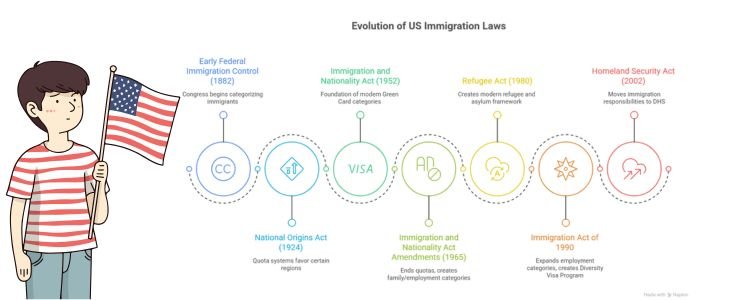
• 1882 – Early Federal Immigration Control
Congress began creating categories of people who could or could not immigrate.
• 1924 – National Origins Act
Created quota systems favoring certain regions.
• 1952 – Immigration and Nationality Act (INA)
This is the foundation of modern Green Card categories and rules.
• 1965 – Immigration and Nationality Act Amendments
Ended the discriminatory quota system and created family- and employment-based categories.
• 1980 – Refugee Act
Created the modern refugee and asylum framework.
• 1990 – Immigration Act of 1990
Expanded employment categories and created the Diversity Visa Program.
• 2002 – Homeland Security Act
Moved immigration responsibilities into DHS, splitting them between USCIS, ICE, and CBP.
Constitutional Foundations
- Article I: Gives Congress power over naturalization and immigration categories.
- Article II: Gives the president authority to enforce immigration laws.
- Article III: Gives courts power to review disputes.
Major Turning Points in Green Card Policy
- Shift from racial quotas to family/employment categories (1965)
- Creation of humanitarian protections (1980, 1990)
- Modern enforcement agencies (2002)
- Court decisions defining limits of executive power
These milestones show how Green Card policy is shaped through a combination of law, administration, and judicial oversight.
How It Works in the U.S. System (Step-by-Step)
(Pure civics explanation)
Step 1: Congress Defines Permanent Residency Categories
Congress decides:
- How many Green Cards are available each year
- Which categories exist (family, employment, humanitarian)
- Eligibility criteria based on the INA
- Per-country limits
- Rules for maintaining LPR status
These rules are written into law and updated through legislation.
Step 2: The President Enforces Immigration Laws
The president oversees:
-
Department of Homeland Security (DHS)
-
Agencies that carry out immigration policies
-
Regulations that interpret congressional laws
The president cannot change Green Card categories alone but can influence how laws are enforced.
Step 3: DHS and Its Agencies Administer Policy
• USCIS (U.S. Citizenship and Immigration Services)
Handles LPR adjudication and interprets INA rules in policy manuals and regulations.
• CBP (Customs and Border Protection)
Manages ports of entry and inspections.
• ICE (Immigration and Customs Enforcement)
Enforces immigration laws within the U.S.
These agencies work together using authority delegated by Congress.
Step 4: Federal Courts Review Disputes
Courts review:
-
Statutory interpretation questions
-
Constitutional challenges
-
Due process issues
-
Disagreements between agencies and individuals
Courts do not create immigration policy but ensure it follows the law and the Constitution.
Step 5: States Influence Related Policy (But Not Green Cards)
States cannot:
-
Create their own permanent residency categories
-
Decide who receives a Green Card
But they may influence:
-
Access to state benefits
-
Driver’s license eligibility
-
Local enforcement cooperation
-
Public services affecting LPRs
Step 6: Public Policy and Rulemaking Shape Future Changes
Agencies create regulations through public comment periods and federal rulemaking processes, which affect how Green Card categories operate.
Examples
Example 1: Arizona v. United States (2012)
Arizona created a law giving local police authority to enforce federal immigration rules.
The Supreme Court ruled that immigration enforcement is primarily a federal responsibility, reinforcing that states cannot create their own residency systems.
This decision protects national consistency in Green Card policy.
Example 2: Kleindienst v. Mandel (1972)
The Court ruled that Congress has broad authority to control immigration categories and admissions.
The decision confirmed that federal agencies must follow congressional rules when interpreting Green Card policy.
Example 3: Executive Branch Policy Shifts (Modern Era)
Different administrations have issued policy memos affecting:
-
Enforcement priorities
-
Adjudication guidelines
-
Visa backlogs and agency resources
Courts often review these to ensure compliance with the INA.
Why This Topic Matters Today (U.S. Society + Politics)
In 2025–2026, Green Card policy affects major national issues:
-
Workforce shortages
-
Family reunification debates
-
Humanitarian protections
-
Economic growth
-
Border management
-
Agency backlogs
-
Election-year policy proposals
Understanding how Green Card policy works helps Americans interpret national debates responsibly.
Current Debates in America
Debate 1: Should Congress Increase Green Card Caps?
-
Supporters cite economic needs.
-
Opponents worry about changing migration patterns.
Debate 2: Should Employment Categories Be Updated?
-
Supporters argue the system is outdated.
-
Others prefer stronger enforcement.
Debate 3: Should Humanitarian Protections Be Expanded?
-
Advocates stress global responsibility.
-
Critics focus on national capacity.
Debate 4: How Should Backlogs Be Addressed?
-
Some want more resources for USCIS.
-
Others prefer stricter limits.
These debates show how different branches shape immigration policy.
Criticisms & Concerns
- Long processing times
- Per-country limits causing backlogs
- Confusing statutory language
- High administrative workloads
- Frequent policy changes
- Complex federal court rulings
Arguments in Favor
-
Ensures orderly immigration
-
Protects national security
-
Maintains consistent standards
-
Supports humanitarian values
-
Balances congressional authority and executive enforcement
-
Allows judicial oversight for fairness
Comparison Table
Congress vs. Executive Branch Roles
| Role | Congress | President / DHS |
|---|---|---|
| Controls categories | Yes | No |
| Sets yearly caps | Yes | No |
| Writes INA | Yes | No |
| Enforces laws | No | Yes |
| Creates regulations | Limited | Yes (Agencies) |
| Judicial review impact | Yes (laws) | Yes (actions) |
State Differences (Boosts U.S. SEO)
States cannot manage Green Card policy, but they influence the experiences of lawful permanent residents:
California
Expands access to state-funded services and education for LPRs.
Texas
Adopts enforcement-focused policies and collaborates closely with federal agencies.
New York
Provides community support and civic participation programs for LPRs.
Florida
Implements strict identification and employment-verification rules.
State environments differ, but Green Card authority always remains federal.
Bottom Line
Green Card policy is shaped by Congress, enforced by the president, implemented by DHS agencies like USCIS, and reviewed by federal courts. States influence related areas but cannot create their own permanent residency systems. Understanding these civics foundations helps Americans interpret immigration debates, Supreme Court decisions, and public policy discussions across the country.
FAQs
Who controls Green Card policy in the U.S.?
Congress controls Green Card categories, the president enforces laws through DHS, and courts review disputes.
What law defines Green Card rules?
The Immigration and Nationality Act (INA) sets permanent residency categories and limits.
Can states create their own Green Cards?
No. Permanent residency is a federal authority under the Constitution.
What role does USCIS play in Green Card policy?
USCIS interprets and implements INA requirements through federal regulations and policy guidance.
Can courts review immigration decisions?
Yes. Courts review due process issues, statutory interpretation, and constitutional questions.
Why does Green Card policy change over time?
Congress updates laws, agencies change regulations, and courts issue new decisions.