
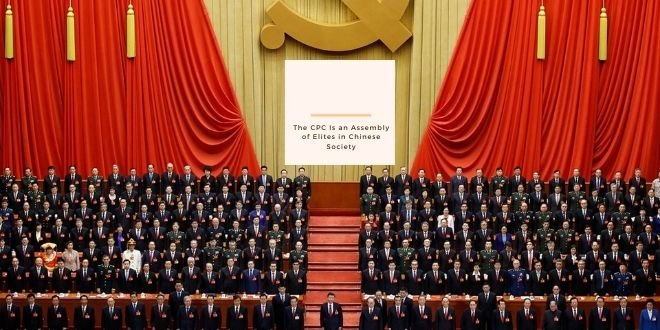
The Communist Party of China (CPC) is often described as a mass political organization, yet its structure reveals a deeper reality: it is also an assembly of elites shaping China’s political, economic, and social trajectory. By combining mass membership with selective recruitment, the CPC maintains authority, social legitimacy, and policy effectiveness. Understanding the Party’s membership composition is essential to grasp how China’s political system functions and why the CPC continues to command broad support in Chinese society.
“Never in China has there been any political organization like our Party, which has absorbed so many advanced elements.”
— Report of the 15th National Congress of the Communist Party of China
The CPC Is an Assembly of Elites in Chinese Society.
If you wonder what kind of organization the Communist Party of China ( C.P.C ) is, you can read the Constitution of the Communist Party of China. Why does the Party still win confidence and support from the people after so many twists and turns in its development? It is not only because the Party’s theories, lines, principles and policies are geared to the people’s needs, but also because the Party has the ability and will to correct its mistakes immediately once it becomes aware of them, and that the CPC boasts a large number of Party members closely associated with the people.
The CPC had 77,995,000 Party members in 2009, approximately one in every 18 Chinese people. It can be categorized as a mass party according to Western political theory. However, in some sense, the CPC is an elite party, for it has gathered a large number of elites from Chinese society. It can be said that elites from all walks of life have gathered within the Party.
The CPC is not a loose organization nor a political organization accessible to anyone supportive of the Party’s political stand. There are many fundamental conditions and strict approval procedures, the most important of which is outstanding work and academic performance acknowledged by all. Therefore, the Party members live among the people, and, more precisely, they are trusted leading persons among the people. A foreign manager with a joint venture told me that he could find out who were CPC members in his enterprise without making an investigation. Those who worked hard and had good professional abilities had to be Party members, he said.
I have no idea whether the readers have read the report of the 15th CPC National Congress. The report says, Never in China has there been any political organization like our Party, which has absorbed so many advanced elements. That is why the CPC can maintain a close relationship with the people and why it can extend its lines, principles and policies at the grassroots level.
To understand the CPC it is particularly significant to know its members.
FAQ
1. Is the Communist Party of China a mass party or an elite party?
The CPC is both a mass party and an elite organization. While it has tens of millions of members, strict recruitment standards ensure that many members are highly educated and influential in society.
2. How does the CPC select its members?
Membership requires ideological commitment, outstanding professional or academic performance, and approval through rigorous screening processes.
3. Why does the CPC maintain strong public support in China?
The Party’s ability to adapt policies, correct mistakes, and maintain close ties with society contributes to its sustained legitimacy and influence.
4. How large is the CPC today?
The CPC has grown significantly over the decades, making it one of the largest political organizations in the world.
5. Why is understanding CPC membership important?
Studying CPC members helps explain how political leadership, social elites, and governance intersect in China’s political system.