
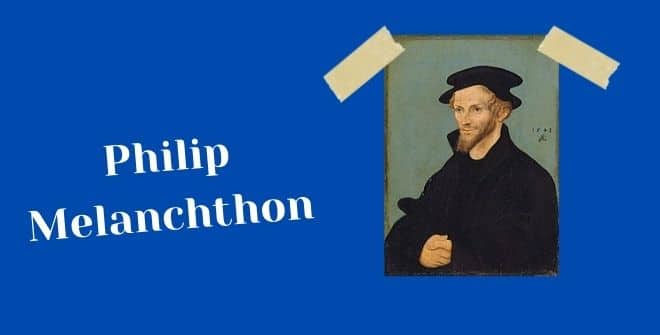
Philip Melanchthon was a German Lutheran reformer, collaborator with Martin Luther, the first systematic theologian of the Protestant Reformation, intellectual leader of the Lutheran Reformation, and an influential designer of educational systems. He stands next to Luther and John Calvin as a reformer, theologian, and molder of Protestantism.
“Natural law, revealed by God and inherent in human nature, guides the state to uphold justice and true religion.” – Philip Melanchthon
Philip Melanchthon
Philip Melanchthon (1497-1560) the disciple of Luther, agreed with his master on the main points of Reformation doctrine but differed in his temperament and his mental outlook. Melanchthon was retiring and scholarly, not practical and aggressive. He represented the influence of the liberal, humanistic spirit and was interested in classical learning.
He drew largely upon the Aristotelian philosophy and the common law, both of which Luther condemned. Melanchthon attempted to create a universal system of moral and political philosophy, taking as a basis the teachings of the Bible.
His chief contribution to the political thought of the period was the emphasis he laid upon the law of nature, thus giving to the Protestant world the same criterion for judging government and law that had been applied by earlier pagan and Catholic writers.
Melanchthon taught that natural law included certain principles implanted in the human mind as direct revelations of God’s will, and certain principles resulting from the nature of man himself. Whatever institutions and laws could be deduced from either of these sources were considered natural and right.
The state was justified as representing God’s will, revealed in Scriptural texts, and as a result of man’s social nature. Accordingly, the state was considered divine and was given large powers.
Melanchthon believed that it was the duty of the state to promote true religion; hence it should prohibit false worship and put down heresies. He justified the confiscation of church property by the argument that the state had the right to take property that was misused by its owner. He upheld slavery and had no sympathy with the peasant revolt.
Melanchthon, like Luther, opposed the monastic ideal, as incompatible with the unity and equality of believers in a Christian commonwealth. He also denied all coercive authority to ecclesiastical rule, saying that the power to make law did not belong to the spiritual sword. He believed that the true communal life is that of the state, and made the church distinctly subordinate to the political power.
Melanchthon upheld the national idea. He rejected the theory of universal empire and argued that the world should be organized into separate and independent states. He supported monarchic government, believed in the divine authority of rulers, and taught the doctrine of passive obedience. As in the case of Luther, his ideas show certain inconsistencies, due to the unsettled condition of thought during the period of revolution.
Some of his writings show that he realized the danger of oppression resulting from the doctrines of divine right and passive obedience, and that, when rulers were tyrannical or when Protestant subjects were ruled by Catholic princes, he was inclined to support the right of resistance. In his later years, Melanchthon was much impressed with the organization of the free cities and was inclined to favor aristocracy rather than monarchy as the best form of government.
FAQ:
Q1: Who was Philip Melanchthon?
A: Philip Melanchthon was a German Lutheran reformer, theologian, and collaborator of Martin Luther who shaped Protestant thought.
Q2: What were Melanchthon’s political ideas?
A: He emphasized natural law, divine authority of the state, monarchic government, and the state’s duty to promote true religion.
Q3: How did Melanchthon differ from Martin Luther?
A: Unlike Luther, Melanchthon was scholarly, humanistic, and drew heavily on Aristotelian philosophy and common law principles.
Q4: What was Melanchthon’s stance on church authority?
A: He denied coercive ecclesiastical power and subordinated the church to political authority while opposing the monastic ideal.
Q5: Did Melanchthon support social reforms?
A: He opposed peasant revolts, supported slavery, and justified confiscation of misused church property, reflecting the complex politics of his time.