
You’d think by now everyone in the US would have figured out the Electoral College, but come election season, it’s still a mystery to a lot of folk. The fact is, the Electoral College, not the national popular vote, gets to decide who ends up as President. If you’re a US citizen, understanding this system can even help you make sense of what’s going on during campaigns, voting strategies and election results. Here, we’ll give you a straightforward step-by-step rundown on how the system works, why it’s still around today and the ongoing debates about it.
Quick Rundown (Just the Basics for US Folks)
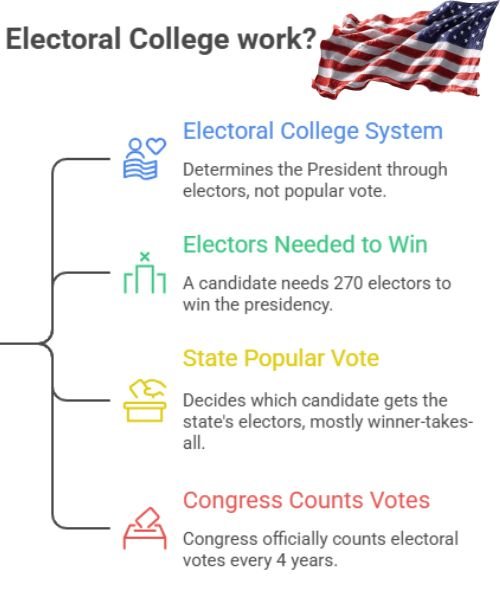
- The Electoral College is that system used by the US to determine who becomes President.
- There’s a total of 538 Electors dotted around the country.
- To win, a candidate needs to get 270 of those votes.
- Your state’s popular vote usually decides which candidate gets its Electors.
- The majority of states use a winner-takes-all system but, interestingly, Maine & Nebraska do not.
- Your national vote total has nothing to do with who actually wins.
- The US Congress is the one that officially counts the electoral votes – every 4 years.
What the Heck is the Electoral College?
The Electoral College isn’t a place, it’s more like a process. It’s the system the US uses to choose the President and Vice President. Every state gets a certain number of Electors depending on how many members it has in Congress – plus its two Senators. Washington DC even gets 3 Electors, despite not being a state. This process turns the whole presidential campaign into 51 separate little elections – one for each state and one for the District of Columbia.
To break it down: You vote, your state picks Electors, and they decide who gets to be President.
A Bit of History (For All You History Buffs Out There)
The Electoral College actually dates back to the Constitutional Convention of 1787. The Founding Fathers debated a few different options, including the idea of a national popular vote and even letting Congress decide who should be President. They eventually went with the Electoral College, and there were several reasons for that:
- They wanted a system that balanced the interests of big and small states.
- They were keen to stop any one particular area dominating national elections.
- They thought a system that reflected the country’s federal nature was a good idea.
- And, to be honest, back in the day, communication and travel were pretty slow, making a national popular vote a real challenge.
Article II of the Constitution and the 12th Amendment set down the rules for who gets chosen as an Elector and how they vote. Over time, states have developed their own rules for picking Electors and awarding those all-important electoral votes.
How it Works (The Nitty Gritty – Step-By-Step)
1. People vote in their own state
On Election Day, citizens go out and cast their ballots for President. But what they’re really voting for is a team of Electors who have promised to vote for a particular candidate.
2. States count up all the votes
The candidate who wins in a state usually gets all of that state’s electoral votes.
3. Electors get together in Decemeber
Electors gather in their state capitals and officially cast their votes for President and Vice President.
4. Electoral votes get sent off to Congress
The results are then sent off to the President of the Senate.
5. Congress counts the votes in January
Congress gets together for a joint session and officially certifies the results.
6. A Candidate needs 270 to win
That’s the majority of all 538 electoral votes.
7. If no-one reaches 270
The House of Representatives gets to choose the President, with each state getting just one vote.
Real-Life Examples (Because You Want to Know How it Really Works)
Example 1: The 2000 Election – Bush vs. Gore
In 2000, Al Gore won the national popular vote but George W. Bush won the Electoral College 271-266 after a real tussle over recounts in Florida. The Supreme Court case Bush vs. Gore (2000) put a stop to the whole recount, and Bush was left ahead by just 537 votes in Florida. Since Florida was a winner-takes-all state, Bush got all 25 of Florida’s electoral votes and won the presidency.
Example 2: The 2016 Election – Clinton vs. Trump
Hillary Clinton won a much larger popular vote, but Donald Trump won a few Really Important swing states – like Michigan, Wisconsin and Pennsylvania. Those electoral votes were just enough to push him over 270. This election is often cited as a good example of how the Electoral College gives a bit of extra weight to certain states.
Example 3: Faithless Electors (2016 and 2020)
Occasionally an Elector doesn’t vote for the candidate they promised to support – these are called “Faithless Electors”. The Supreme Court case Chiafalo vs. Washington (2020) made it clear that states can actually punish or even remove these faithless electors, giving the states a bit more control over the process.
Why This Topic is Still Important Today
The Electoral College has a huge impact on how presidential candidates choose to run their campaigns, and which states they spend the most time in. Presidential hopefuls are often very focused on winning swing states like Pennsylvania, Georgia, Wisconsin, Arizona, and Michigan, even if these states have fewer voters than places like California or Texas. However, in the end it’s these swing states that can hold the key to winning a close election.
By 2025-2026, there will be a big debate going on about whether or not the United States should keep, modify or scrap the Electoral College altogether. A lot of people think that this is more relevant than ever due to escalating political polarization, closer election margins, and arguments over who actually won based on election results.
The Great American Debate
Arguments for ditching the Electoral College:
- We should decide who wins based on the popular vote, not some arcane system that only serves to confuse people.
- Because some states are so solidly ‘blue’ or ‘red’, lots of our votes can feel like they’re effectively pointless.
- There are only a handful of states that really matter, which is just crazy.
- It’s not inconceivable that a candidate could win the presidency without actually getting the most votes.
Arguments for keeping the Electoral College:
- It stops larger states from getting too much power at the expense of smaller states.
- It means that presidential candidates have to think about the whole country, not just one section.
- It’s a good way to reflect the overall structure of the U.S. government.
- It stops a couple of large cities from dictating the course of the whole election.
It’s worth noting that both sides of the argument have pretty valid reasons based on constitutional, practical and political grounds.
Where Things Can Go Wrong:
- The influence of different states on the outcome of the election can be huge, which is not fair.
- In winner-takes-all systems, a lot of smaller parties get left behind.
- Sometimes electors can vote against who they were supposed to vote for – a problem known as “faithless electors”.
- If there is a dispute over who won in one or more states, things can get really messy.
- And if no one has got over 270 votes, the House of Representatives has the final say in who becomes president.
Why It’s Worth Keeping:
- It helps make sure that small states get to have a say in the election.
- It means that presidential candidates have to appeal to voters all over the country, not just in certain areas.
- It means that a candidate who is local to one region can’t win without having a following elsewhere.
- It helps stop the two-party system from getting too dominant.
- It’s just the way it has always been, and it’s stuck in our constitution.
How It Works
| Feature | Electoral College | National Popular Vote |
|---|---|---|
| Winner decided by | 270 electoral votes | Most individual votes |
| State influence | High | Low |
| Swing states | Major role | No special role |
| Risk of split vote | Yes | No |
| Constitutional change needed | Yes | Possible via compact |
| Campaign strategy | State-based | Nationwide |
State Differences
Most states use winner-take-all, meaning the candidate who wins the popular vote gets all the state’s electors.
Two major exceptions:
-
Maine
-
Nebraska
These states use the Congressional District Method, where electoral votes can be split based on district-level results.
Battleground states with high influence include:
- Pennsylvania
- Georgia
- Arizona
- Wisconsin
- Michigan
- North Carolina
States with predictable outcomes (“safe states”):
-
Democratic-leaning: California, New York, Massachusetts
-
Republican-leaning: Texas, Oklahoma, Wyoming
Understanding these state differences helps Americans see why their vote matters differently depending on where they live.
The Bottom Line
The Electoral College is the system that the U.S. uses to choose who will be president. Even though the popular vote says who Americans tend to like, the reality is that it’s the electoral college votes that decide who actually wins. And it’s this system that paves the way for the whole country to be included in the election process, and has the power to shape campaign strategies and spark debates.
Top Questions about the Electoral College
What is the Electoral College in simple words?
It’s the process that the U.S. uses to choose a president. Each state gets a set of electors, and the candidate who gets the most of these electors wins.
Why does the U.S. have the Electoral College?
It was created so that smaller states wouldn’t get left behind by larger states, and to reflect the overall structure of the U.S. government.
How many electoral votes does each state get?
Each state gets two for its senators, plus a couple more for each representative that state has.
Can someone win without getting the most popular votes?
Yes, and it’s happened twice in the last twenty years because the electoral college votes are what actually decide who wins.
What happens if no one has got over 270 votes?
The House of Representatives gets to choose who becomes president, with each state delegation getting a single vote.
Can an elector vote for someone else rather than who they said they’d vote for?
Most states say no, after a U.S. Supreme Court case in 2020 which said that it’s okay to punish any faithless electors.
Why are swing states so important?
Swing states can vote for either candidate, which is why presidential hopefuls spend so much time and money on them.