Dante Alighieri and the Logic of Imperial Authority
Dante Alighieri

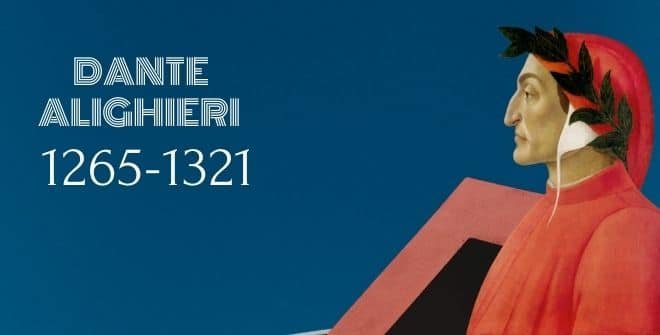
The most logical and systematic statement of the imperial theory was that of Dante Alighieri (1265-1321 ). Dante had considerable experience in the politics of his city (Florence); and in his wanderings from city to city and from court to court during his long exile, he gained valuable knowledge and experience. “The best peace is … Read more
Fourteenth Century Church and State Controversies: The Decline of Papal Supremacy

The Fourteenth Century Controversies

The Fourteenth Century Church and State Controversies marked a turning point in European political history. The conflict between Pope Boniface VIII and Philip IV of France ignited a broader struggle between ecclesiastical supremacy and emerging national monarchies. From the Avignon Papacy to disputes with the Holy Roman Emperors like Louis IV, this period reshaped medieval … Read more

Saint Thomas Aquinas: Medieval Political Philosophy and Law

Saint Thomas Aquinas

Saint Thomas Aquinas (1227–1274), the eminent Italian Dominican theologian, remains a cornerstone of medieval scholastic thought. He harmonized reason and faith, integrating Aristotelian philosophy with Christian doctrine. His insights on natural law, political authority, and the relationship between church and state shaped Western political philosophy, emphasizing justice, monarchy, and divine guidance. “Law is an ordinance … Read more

St. Bernard and John of Salisbury: Church Supremacy and Medieval Political Thought

St. Bernard and John of Salisbury

The twelfth century witnessed intense debate over the relationship between spiritual and secular power. Two of the most influential thinkers in this debate were St. Bernard of Clairvaux and John of Salisbury. Both defended the supremacy of the Church while criticizing its moral corruption. Their writings shaped medieval political theory, influenced constitutional development, and strengthened … Read more

Arguments for Secular Supremacy: The Rise of Imperial Authority Over the Church

Arguments for Secular Supremacy

The doctrine of secular supremacy emerged as a powerful counterforce to papal authority during the Middle Ages. While the Church claimed spiritual dominance over temporal rulers, secular monarchs asserted that political power was equally divine in origin and accountable only to God. Influenced by revived Roman law and scholars at the University of Bologna, jurists … Read more

Arguments for Ecclesiastical Supremacy in Medieval Political Thought

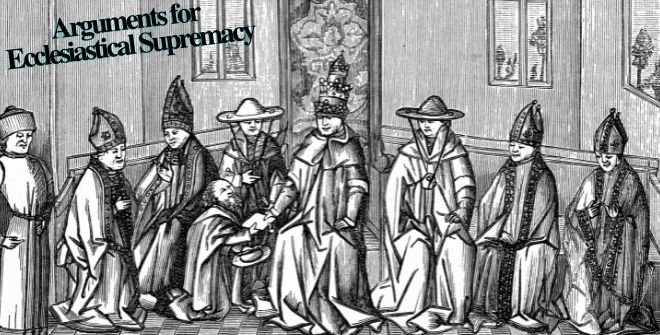
Arguments for Ecclesiastical Supremacy

Between the ninth and fourteenth centuries, the doctrine of ecclesiastical supremacy shaped the political and religious landscape of medieval Europe. Influential figures such as Pope Gregory VII, Pope Innocent III, St. Bernard of Clairvaux, John of Salisbury, and St. Thomas Aquinas advanced theological and legal arguments asserting the supremacy of spiritual authority over secular rulers. … Read more

The Nature of Medieval Political Thought: Church, State, and Divine Authority

The Nature of Medieval Political Thought

Medieval political thought was shaped less by empirical observation and more by theological doctrine and inherited tradition. From the fall of the Roman Empire to the rise of modern nation-states, political ideas were dominated by Christianity, feudal relationships, and lingering Roman influences. Thinkers such as St. Augustine, Gregory the Great, St. Thomas Aquinas, and Pope … Read more

The Conflict Between Church and State: Spiritual vs. Secular Authority in Medieval Europe

The Relation of Spiritual to Secular Authority

The conflict between church and state shaped the political structure of medieval Europe for centuries. From the early recognition of emperors as heads of both state and church to the dramatic power struggles between popes and monarchs, the relationship between spiritual and secular authority transformed Western political thought. The clash reached its height during the … Read more

Feudalism in the Medieval Era: Origins, Structure, and Political Impact

Feudalism in Medieval Era

Feudalism in the medieval era shaped the political, economic, and social foundations of Europe between the 9th and 15th centuries. Emerging from the collapse of the Western Roman Empire and influenced by the customs of the Teutonic peoples, feudalism became a decentralized system based on personal loyalty, land tenure, and mutual obligation. Kings, nobles, knights, … Read more