
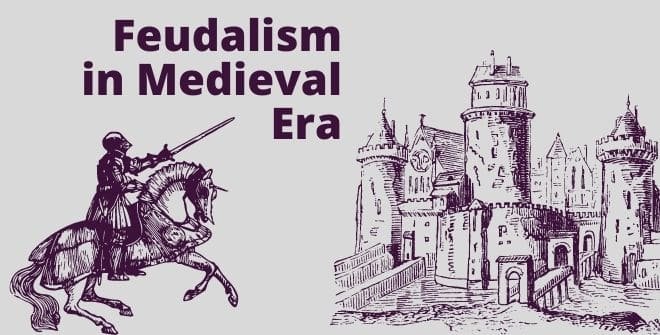
Feudalism in the medieval era shaped the political, economic, and social foundations of Europe between the 9th and 15th centuries. Emerging from the collapse of the Western Roman Empire and influenced by the customs of the Teutonic peoples, feudalism became a decentralized system based on personal loyalty, land tenure, and mutual obligation. Kings, nobles, knights, and peasants were bound together through contracts of service and protection rather than centralized national authority. While feudalism limited political unity, it laid the groundwork for constitutional principles, contractual governance, and the eventual rise of modern nation-states in Europe and later influenced Western political development, including foundational ideas in the United States.
“Feudalism was not the rule of territory, but the rule of personal loyalty — a chain of obligations that bound medieval society together.”
Feudalism in Medieval Era.
From the point of view of political institutions, the early medieval period was characterized, not only by the formation of a powerful ecclesiastical organization that exercised extensive political authority but also by a contest between two forms of society, the patriarchal, and clan type, as represented by the Teutonic barbarians and the imperial state type, as represented by the Roman Empire.
The compromise form of organization that resulted from this contest was called feudalism. In its earlier stages, it seemed to have more of the personal clan than of the territorial state in its composition, but by the tenth and eleventh centuries the state idea was revived, and by the close of the medieval period it was completely successful, both the clan and the church has failed in their efforts to retain political power.
The Teutonic invaders were warriors, organized under a military leader. They were held together by ties of kinship and by vows of personal allegiance. Their organization was decentralized, emphasizing local independence. They were in a low stage of economic development, caring little for industry or commerce, but eager to secure land.
During the period of the conquest and break-up of the Western Empire, the barbarian bands had organized into armies of considerable size, whose leaders had attempted to rule over large fragments of the empire. In this process, the Frankish rulers had been most successful.
Having upheld the cause of Christianity against both Pagan and Saracen and having become the actual possessor of imperial authority over a large part of the ancient empire, the Frankish king Charlemagne was formally recognized by the pope as the successor of the Roman emperor.
However, these early attempts at state-forming were too ambitious, and even Charlemagne’s empire fell to pieces shortly after his death. Local officials and great landowners became a law unto themselves, and in the anarchy that followed, bonds other than political had to be found to hold society together and to maintain order and protection.
Such bonds, in addition to those furnished by the church, were found in personal relations among men and in a system of dependent land tenure, with which governing authority was associated. The peasants on the land needed protection, which the lords who held the land could furnish, but which bound the peasants to the soil and compelled certain obligations.
Men unable to make an independent living “commended” themselves to some great man on the understanding that he would support them and they would serve him. Warriors attached themselves as personal friends and followers of some powerful chief.
Land grants were made by the kings and the great nobles to their followers, with the understanding that certain services, especially military, would be required. The church was also drawn into this system, and a complex set of personal, local relationships based on landholding was built up.
Feudalism was essentially personal, private, and non-political. Anyone who was able to wage war coined money and held courts of justice. In it, men paid feudal aids, not taxes; they owed knight service instead of forming standing armies; they gave court attendance instead of creating a parliament; they were vassals, not citizens, Personal lordship and dependent land tenure took the place of modern nationality and territorial Sovereignty. The power of the feudal lords was distinctly limited. A contract, expressed or understood, defined the relations between the lord and vassal.
Feudal territories were small and scattered, although efforts were made to unite adjacent holdings and to follow geographic and racial lines. By its very nature, feudalism prevented the idea of an absolute authority ruling within a definite area. Its theory required a succession of lordships within lordships, with no one having complete sovereignty.
The modern conceptions of sovereignty and law were entirely foreign to the Middle Ages. Law was primarily custom, and existed as a part of local or national life; it was not the command of a lawmaker nor the will of the community. Legislation was merely the promulgation of what was already recognized as binding upon men.
Although certain valuable elements were contributed by feudalism to modern institutions, and although modern national states were finally formed by combining these feudal fragments and centralizing authority within them, real political progress was impossible as long as feudal ideas held sway.
At the same time, feudal theory was not entirely anarchic. The personal relations of feudalism were based upon definite ideas of loyalty and contract, and lord and vassal were equally obliged to obey and maintain the law which prescribed their mutual rights and duties.
Besides the idea grew steadily that beyond the obligation to his immediate overlord, every freeman owed direct allegiance to the king, and this principle hastened the growth of national states. In these, the feudal theory taught that rulers as well as subjects were bound to obey the law. The conception that the landowner is bound to render service, in war and peace, to the community was also a valuable contribution.
FAQ
Q1: What was feudalism in the medieval era?
Feudalism was a decentralized political and social system based on landholding, personal loyalty, and military service in medieval Europe.
Q2: Why did feudalism develop after the Roman Empire fell?
After the collapse of the Western Roman Empire, centralized authority disappeared. Local lords provided protection in exchange for service and land obligations.
Q3: Was feudalism political or economic?
It was both. It organized political authority and structured economic life around land ownership and agricultural labor.
Q4: How did feudalism end?
Feudalism declined as monarchies centralized power, trade expanded, and national states emerged between the 13th and 15th centuries.
Q5: Did feudalism influence modern democracy?
Indirectly, yes. Concepts such as contractual governance, legal limitation of rulers, and mutual obligations influenced later constitutional systems.